First of all, you should know the frequency that the tanpura maker intended to make this tanpura for.
For example, this tanpura was made for C#. I understand that it’s not fixed and we can tune it somewhat lower or higher, but this original frequency that was taken as reference by the tanpura maker is very important, because often the acoustics work best if you stick to this original frequency. Because everything is kind of optimized for this frequency.
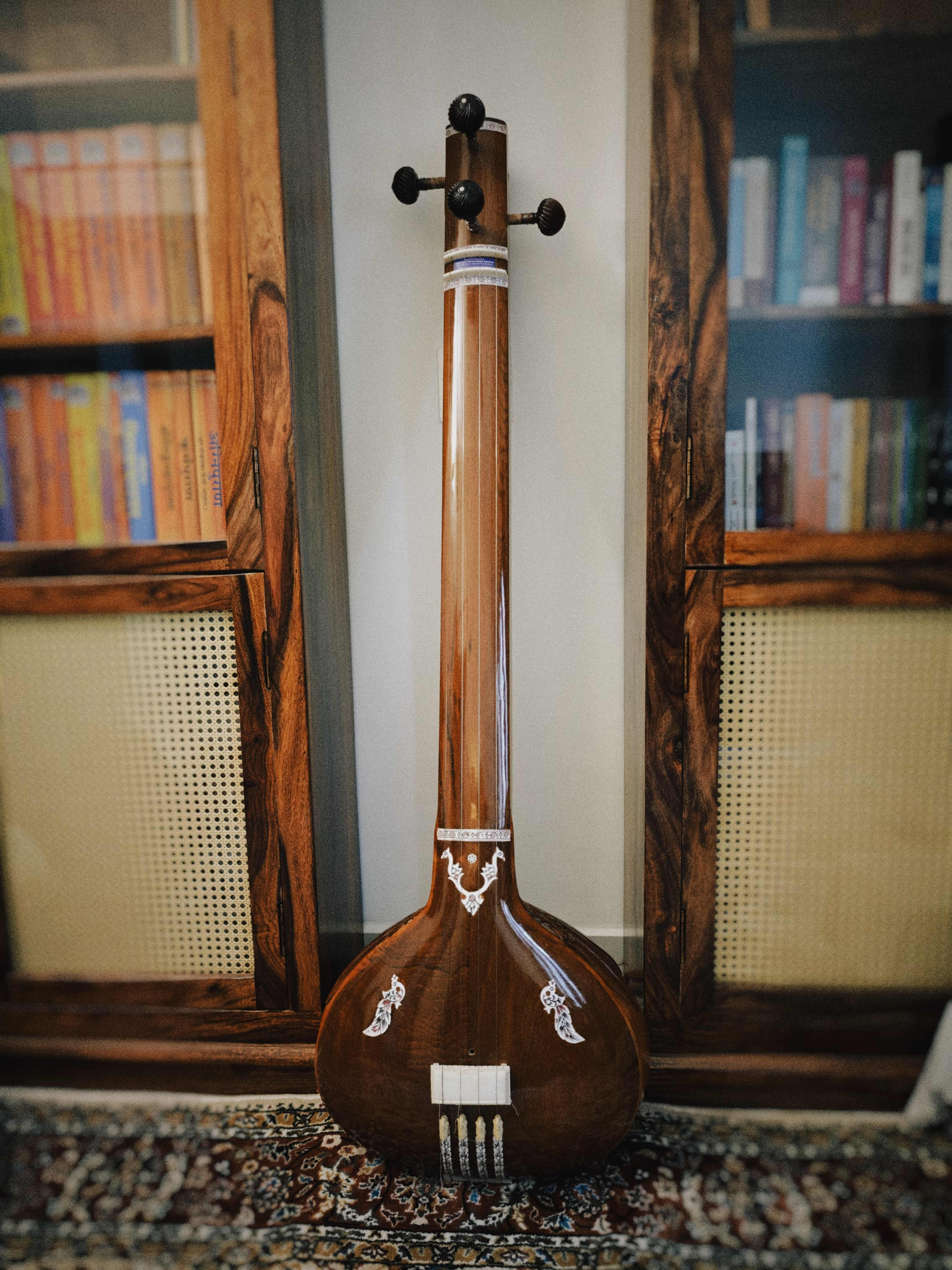
Now, let’s assume the tanpura is completely out of tune. The strings are all loose. The microtuning beads are all the way up (loose). And jawari thread is misplaced (so there is no buzzing).
So, let’s say we intend to tune the tanpura in C# frequency. C# of second octave is roughly 69.3 Hz. Likewise, the C# of third octave is double of that, which is 138.6 Hz.
Now, as tanpura has four strings. The middle two strings will be tuned to 138.6 Hz, and the lower Sa (the thick string) will be tuned to 69.3 Hz. And what remains is the first string (rightmost string if you look at tanpura from front).
This first string is usually tuned to Pa. But also sometimes to Ma and sometimes to Ni, depending on the rāga.
The Pancham (Pa) in Indian system, is 3/2 of Sa. The Shuddha Madhyam (Ma) which we require here, is 4/3 of Sa. And the Shuddha Nishad (Ni) we require here, is 15/8 of Sa.
You can check these ratios here - 22 Śrutis in 500 Rāgas.
So, to summarise, we can have three ‘types’ of tuning, as follows,
| String 1 | String 2 | String 3 | String 4 | |
|---|---|---|---|---|
| Pa Sa Sa Sa | 103.95 Hz | 138.6 Hz | 138.6 Hz | 69.3 Hz |
| Ma Sa Sa Sa | 92.4 Hz | 138.6 Hz | 138.6 Hz | 69.3 Hz |
| Ni Sa Sa Sa | 129.94 Hz | 138.6 Hz | 138.6 Hz | 69.3 Hz |
Now, to measure the frequency, you can use a device. Or a software like Swar Alap on Android. How do you measure? You pluck the string and look in the app. It should show the frequency atleast till one decimal place.
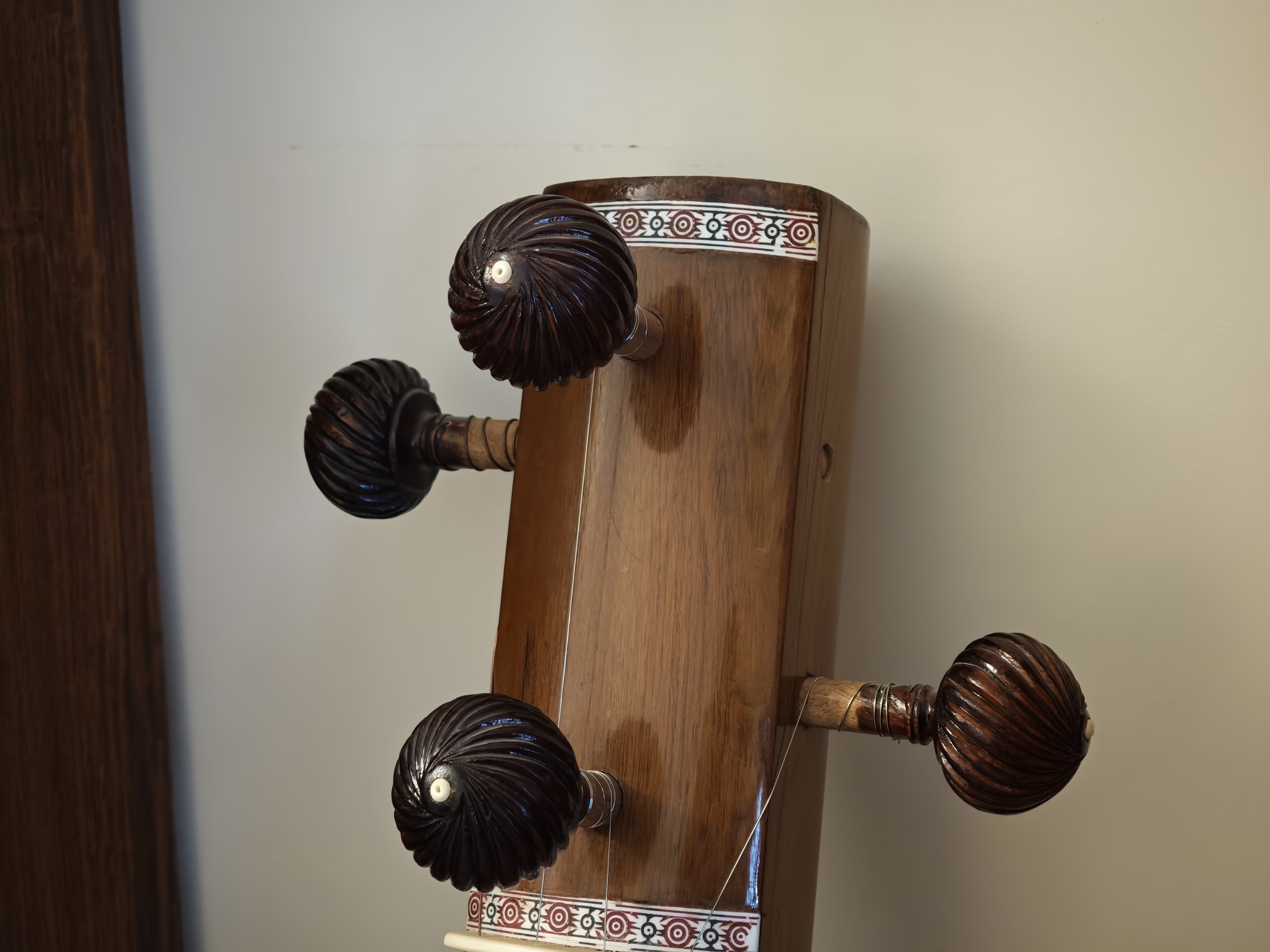
Okay, now the tuning mechanism.
These four knobs on top determine how tight of loose the strings are. One knob for each string. You pluck a string, and turn the knob in one motion to make it a higher frequency.
So, let’s tune the second string first. It has to be tuned to 138.6 Hz. So, when you pluck the loose string it will show perhaps very low or even trembling frequency. You then tighen the knob and bring to closer to 138 Hz. Don’t make it exact here, leave some space. We will fine tune this using beads instead. If you tune it exactly 138.6 Hz using these top knobs, then even when you lift the tanpura upright, the frequency can increase a bit. So then you won’t be able to decrease the frequency using beads (because those were already fully loose). You can only increase the frequency with the beads.
So, tune the second string close to 138 Hz. Similarly, tune the third string to 138 Hz or something close. Middle two strings done. Now tune the lower Sa, the thick string. Tune it to 69 Hz perhaps. Little breathing space for fine tuning with beads.
All good, now tune the first string. Assuming we are tuning it to Pa. Bring it closer to 102 or 103 Hz.
Now, place the tanpura upright on your lap. (Because until now it was lying down, you know). To tune the top knobs, we kept the tanpura on the floor (on a mat), and with our right hand we plucked the strings and the left hand turned the knobs.
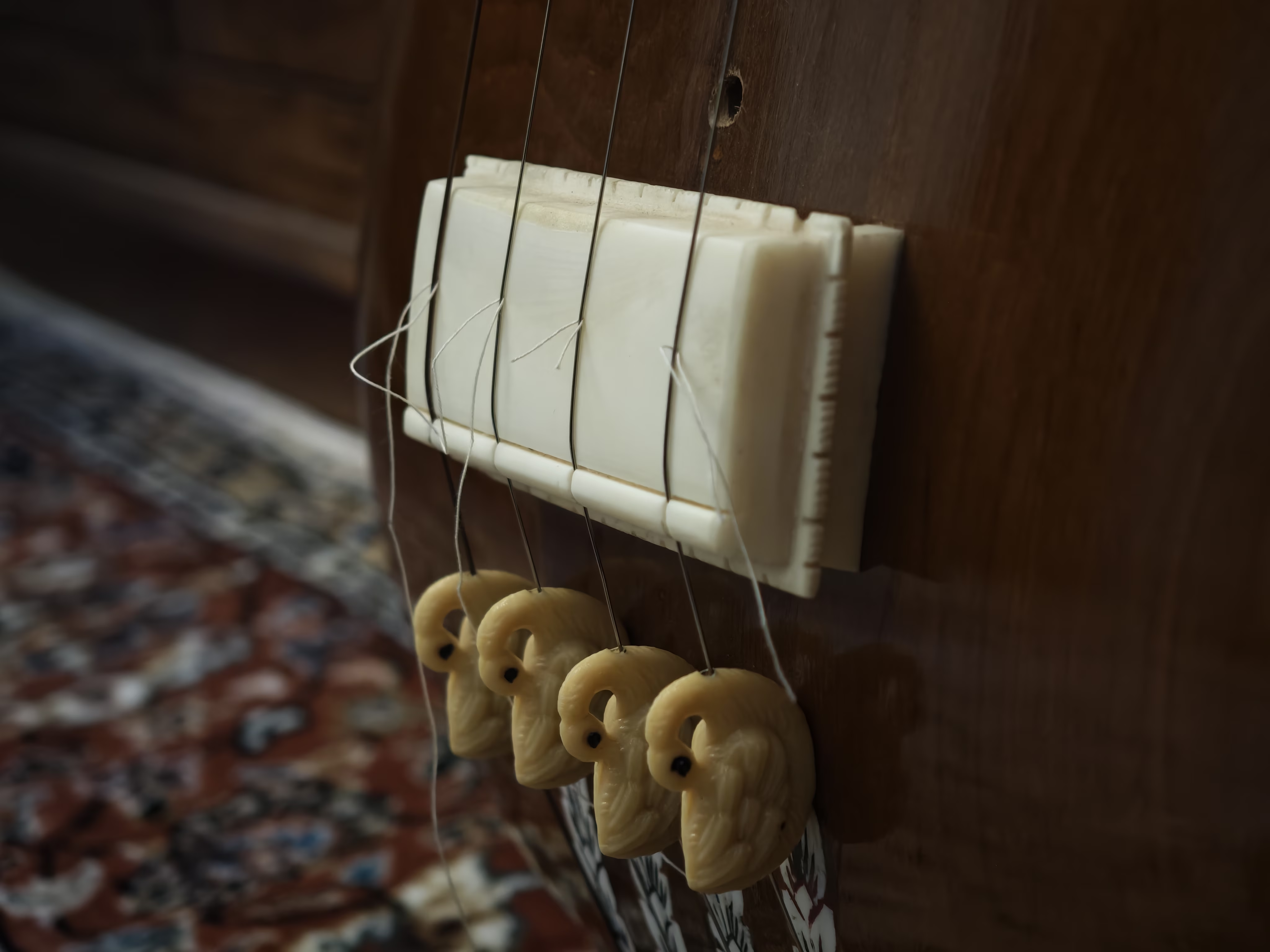
Now, coming to the fine tuning with beads. These swans, you see, if you bring them lower it tightens the string, which increases the frequency. So, since we kept some space from our desired frequency. We can bring these beads lower slowly and check that we achieve the exact frequency mentioned on the above table.
The device or app will show you the frequency, but the final judgment will be from the ear.
How do you tighen these beads? The tanpura is on your lap. Turn the tanpura a little, so that you can see the beads sideways. Now, with your right hand you pluck the string, and the left hand carefully pushes down (or up) the beads.
First of all, the middle two string must be made exactly equal. Pluck them one after another, and do the beads tuning until you’re satisfied.
Then, tune the lower Sa. This is difficult. But final goal should be, that when you pluck two middle Sa followed by lower Sa, you feel that there is no dissonance.
At last, tune the first string. To Pa, or Ma or Ni, whatever chosen. The goal here, is that when you pluck the Pa followed by any of the middle Sa, you should hear the consonance.
Okay, assuming the strings are all in tune now. We come to the jawari thread. If the thread is absent or misplaced, the strings will not buzz. This is the heart of the tanpura. Without this, there is no use of the tanpura. Because this is what creates the harmonic profile. And this is what makes tuning the tanpura non-trivial. Because tuning the string to fundamental frequency is easy. But to bring out the consonance or proper mingling of the harmonics from each string, that is not very easy.
But, anyway, the jiva, or the thread, actually only determines the buzz, and not the frequency directly. So, to place the thread correctly, you pluck the string with your right hand, and with the left hand you move the thread to its correct position. What correct position? Basically you move it until you hear the buzzing sound. And goal here is to see that we get the best buzzing sound, which means most prominent and that which sustains longest.
Usually, even after the jiva, you will need to fine tune the beads again. Because small differences occur.
The final goal of tuning the tanpura, is that you will not hear four individual strings, but one unified sound. A cloud of shrutis. When the tanpura ‘locks-in’, you will know! It suddenly elevates the mind. It is no longer mechanical strings playing the frequency, it becomes something magical.
Some more observations,
- If the strings are tuned well, when you pluck the lower sa, it will make the middle sa vibrate. Sympathetic vibration! Usually I’ve heard only one of them vibrate at a time. But I suppose both should vibrate with just plucking the lower Sa.
- The Pa string, when plucked, will cause a strange vibrating-air like sound in the whole instrument. This is to say that the Pa string also affects the other three strings. Because this phenomenon only happens when Pa is tuned well corresponding to the Sa strings.
- And of course, the lower Sa, will produce strong harmonics. You can easily hear Ga, for instance.
- Playing Pa, followed by any middle Sa, you will notice the consonance. It feels like very tiny and numerous waves coming together. This will not happen if Sa-Pa ratio is not tuned well.
Strangely, it is not certain that you will always be able to tune the tanpura very well.
I mean, of course, you can come very close. And it will be all correct, so to say. But the ‘magic’ may be missing.
It’s very hard to be deterministic here. Because it’s a physical instrument. There is wood, the strings, the complex jawari. And so many things going on, it is clearly not as deterministic as let’s say calculating 2 + 2 = 4 on a calculator.
And even if you may be able to tune it well, it can take different amount of time on different days. Some days, it will be done in 2 mins. Other days, you keep trying for 20 mins.
This slight indeterminism, as with all things Indian, makes way for divine help. You need some divine help to tune the tanpura! I mean, if there is some divine help, it makes things so much better.
Now, the difficult part in tuning the tanpura, as I mentioned, is the harmonic profile.
Each string, apart from its fundamental frequency, is producing harmonics in 2x, 3x, 4x and so on, and these determine the shrutis which emanate out of the tanpura.
These shrutis form a cloud. In that cloud-atmosphere of correct shrutis, rāgas come on their own. They approach you on their own.
And without that shruti cloud? You try so hard to call the rāga, but it just won’t come.
Now, this part, obviously, I cannot speak much about. It requires judgment from the ear. Only those who understand the shrutis themselves, can do this part well.
For all people below that level of ability, I would just say pray to God that the tanpura may be tuned very well according to what you are going to sing.
Or, you can first tune the tanpura, and then listen what it is saying. The rāga that comes to your mind on its own, will perhaps be the correct one for the day.
Thank you.
:)